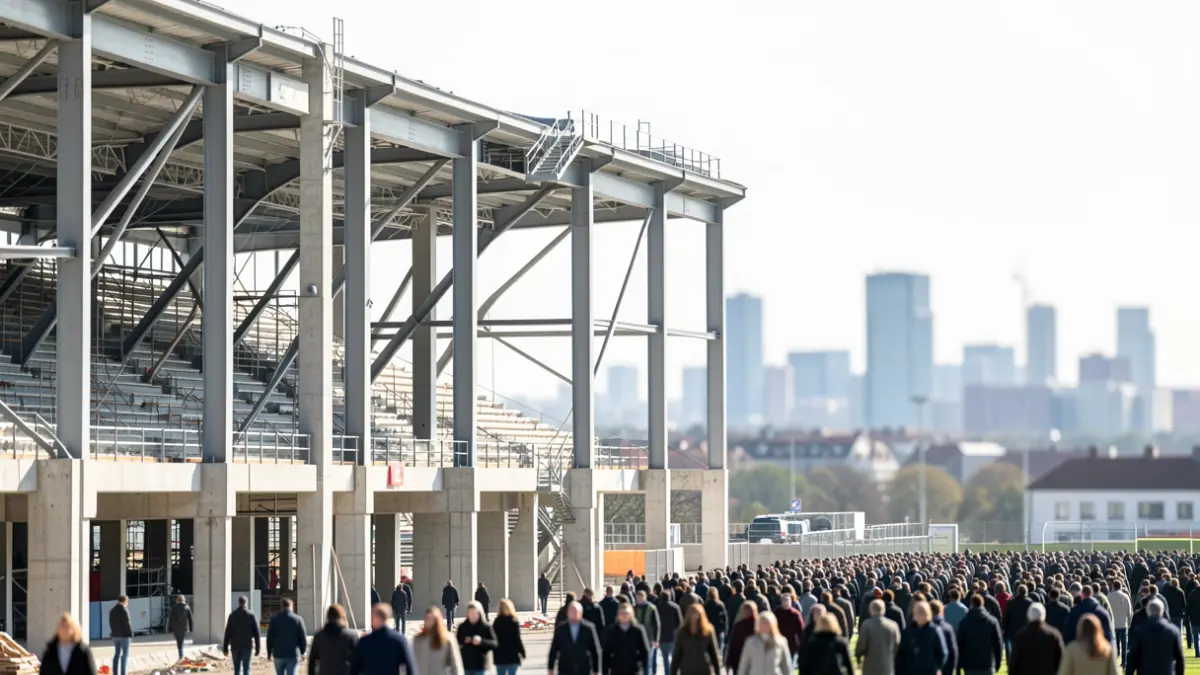
Valencia CF is designing its future stadium, the Nou Mestalla, with the vision of transforming it into much more than just a sports venue. The intention is for the stadium to host sports, leisure, and business events practically all year round, with technology as a central axis to enhance the attendee experience. Among the planned functionalities is a mobile application capable of recommending the least crowded queues in real-time, nearby services, or even offering seat upgrades for matches.
This was explained by Pablo Rojas, Director of Information Systems (CIO) of Valencia CF, during the round table "Valencia Conecta: digitalization and technological leadership," held as part of Telefónica Day at the Palau de Les Arts Reina Sofía. The debate also included David Carrasco (CISO of SanLucar), Ana Cerqueira (CISO and Head of Business Continuity at Bit2Me), and Pascual Sanchís (Head of Large Business Sales for Telefónica in Valencia and Castellón). The conversation focused on how technological innovation helps companies improve efficiency, security, and customer relationships.
Rojas detailed how the Nou Mestalla project necessitates rethinking the role of technology in a sports organization, preparing it for a broader operational model. "Stadiums are now focused on having as many leisure as business events 365 days a year, and this multiplies the needs to cover this scenario," he noted, highlighting the shift from 18 years ago when the focus was solely on what happened on the pitch.
The Nou Mestalla has been conceived as a smart stadium where connectivity, data, and user experience will be closely linked. The goal is for technology to be an integral part of the venue's entire operation. "Our objective is for the stadium, the technology, and all departments to work in a coordinated manner to offer the best possible experience to the fans," he affirmed.
One of the main challenges has been connectivity. The club has sought to develop a scalable technological infrastructure, with the support of Telefónica as a technological partner. "Connectivity is very important for us because we have tried to create a design that can be extended to future needs," commented Rojas. The real challenge, he explained, is to transform the available "mountains of data" into useful services for users, such as an application that guides towards less crowded queues, indicates restrooms with lower occupancy, or offers seat upgrade options at an additional cost.
Cybersecurity is another fundamental pillar. Rojas warned that a more connected stadium increases exposure to attacks, making system protection a priority to avoid "significant reputational risk" from potential security breaches.
During the event, Ana Cerqueira (Bit2Me) reviewed the evolution of the Valencian company and the impact of new European regulation on cryptoassets, while David Carrasco (SanLucar) stated that security is integrated into the company's entire value chain, evolving towards a resilience-based approach. Pascual Sanchís (Telefónica) emphasized the need to incorporate security from the design phase of technological projects.
The Telefónica Day brought together nearly 200 professionals to discuss the practical application of technologies such as artificial intelligence, Big Data, IoT, and 5G. Telefónica presented around 25 technological solutions, including proposals from Mobile World Congress 2026 like Mission-Critical Dome and Titán Connect, and highlighted its deployment of 17 edge computing nodes in Spain, one of them in Valencia.