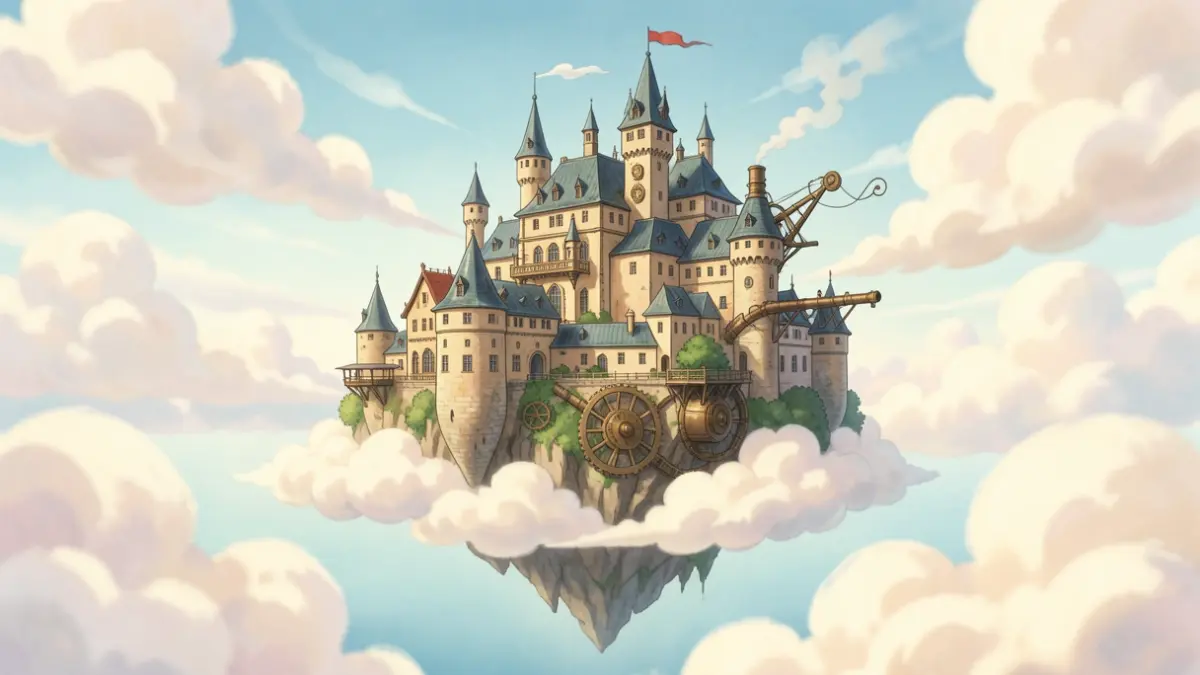
With Studio Ghibli established as a global artistic benchmark, its films continue to reach cinemas, offering a unique opportunity to rediscover masterpieces on the big screen. This re-release of Castle in the Sky, coinciding with its 40th anniversary, allows us to celebrate the art of hand-drawn animation in the age of artificial intelligence.
This film, considered by some a 'minor title' within Ghibli's filmography due to being surrounded by such celebrated works as Nausicaä of the Valley of the Wind, Grave of the Fireflies, or My Neighbor Totoro, is in reality the studio's first official film. It premiered in a market dominated by OVAs but already potentially contained all the major themes that would guide Hayao Miyazaki's career.
Among the prominent themes are militant anti-war sentiments, with military figures seeking to exploit the technology of the floating castle of Laputa (or Lapuntu) to manufacture weapons. Environmentalism is also revealed, as the imperative need to preserve nature from human intervention, and the appearance of the supernatural in everyday life, with the arrival of a girl possessing a magic stone that alters the life of the young miner Pazu.
Stylistically, Castle in the Sky draws from sources such as Jonathan Swift's Gulliver's Travels, Albert Robida's flying machines, and the magical objects that foreshadow Howl's Moving Castle. It also features elements like pirate bands, already present in Porco Rosso, and the feisty elderly women we would later see in Spirited Away, shaping a steampunk aesthetic that marks the genesis of many subsequent works.
The influence of Castle in the Sky extends to contemporary works, such as the Laputian robots reminiscent of Brad Bird's The Iron Giant, or the narrative of Disney's Atlantis. In the world of video games, its footprint is visible in The Legend of Zelda: Tears of the Kingdom and Breath of the Wild.
The reason it is considered a minor title might lie in its purely childlike nature, similar to Ponyo on the Cliff by the Sea. According to Hayao Miyazaki's diaries, the original project, named Pazu, was conceived to be primarily fun and action-packed for children, unlike the seriousness and transcendence of Nausicaä. This intention for lighthearted fun and the simplification of lines to de-dramatize the imagery make the film more for enjoyment than for deep thought, turning it into a unique 'Doraemon' within Ghibli's complex universe.