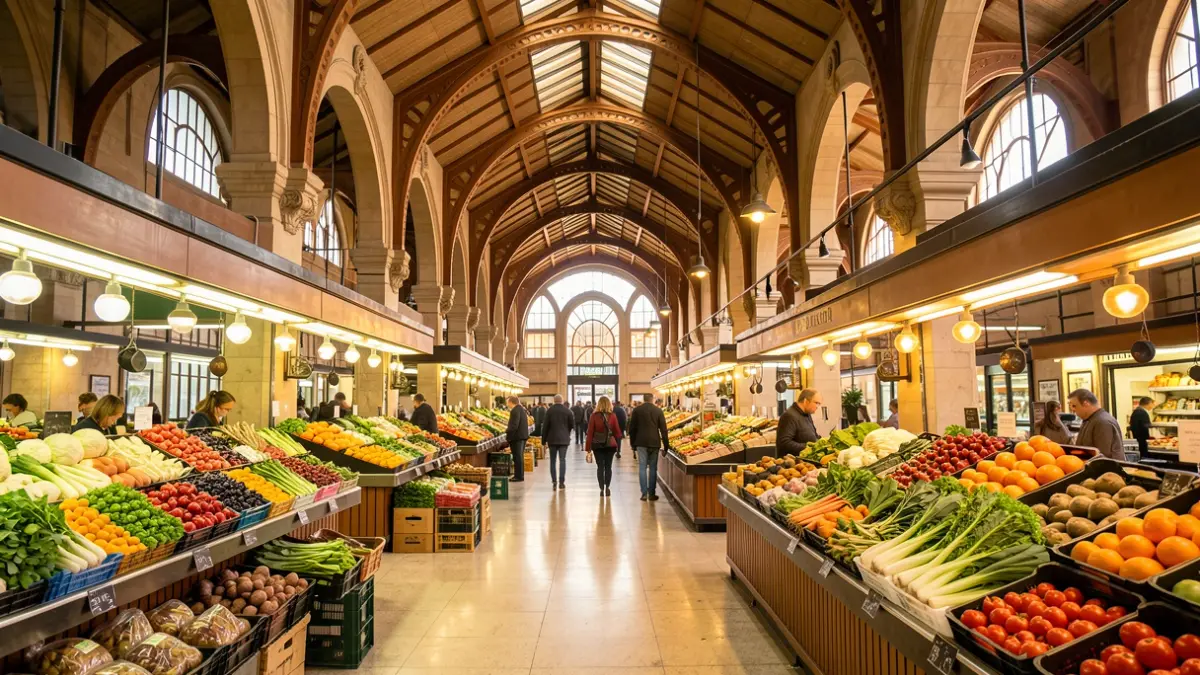
The plan to combat high temperatures in the Central Market of Valencia during the summer could cost around 980,000 euros. This is estimated by a study carried out by the Institute of Energy Engineering of the Polytechnic University of Valencia (UPV), which the City Council commissioned in July 2025 as a preliminary step to the air conditioning project. The report proposes measures such as solving condensation problems in the current cooling system, installing more industrial fans, or creating a digital twin to monitor temperature.
This document confirms the diagnosis that both vendors and customers suffer every summer: high temperatures that even affect the merchandise. On-site measurements reveal that during the summer campaign, especially in July and August, the interior of the modernist complex reaches temperatures between 28 °C and 30 °C.
According to the researchers, the origin of the problem lies in the original air conditioning system, designed in 2002 to lower the temperature by about 8 °C compared to the outside, is not operating at maximum performance. The main issue is a fault in the generation and evacuation of condensation water from the cooling units (fancoils). Furthermore, the numerous split-type air conditioning units installed by the merchants themselves have saturated the common air, altering its circulation and reducing the efficiency of the central system.
As complementary measures, it is proposed to improve the collection of hot air, change the metal floor of the hoists to grilles to facilitate the rise of cold air from the basement, and install 16 industrial fans at height. The estimated budget for this first block is around 120,935 euros.
The second stage focuses on digitalization through a 3D Digital Twin in the cloud connected to a network of sensors. This virtual replica would allow simulating the building's behavior against heat and humidity, better adjusting air conditioning, and reducing energy consumption. An estimated cost of 485,502 euros is allocated for this initiative.
The third block proposes physically expanding the cooling system on the main floor with 18 new diffusers in the central aisle, pending authorization from Heritage. The estimated budget is 372,791 euros.
Finally, the report addresses energy efficiency. Since solar panels cannot be installed on the protected roof, external alternatives are proposed, such as joining a local energy community or using nearby public roofs to generate clean energy.