
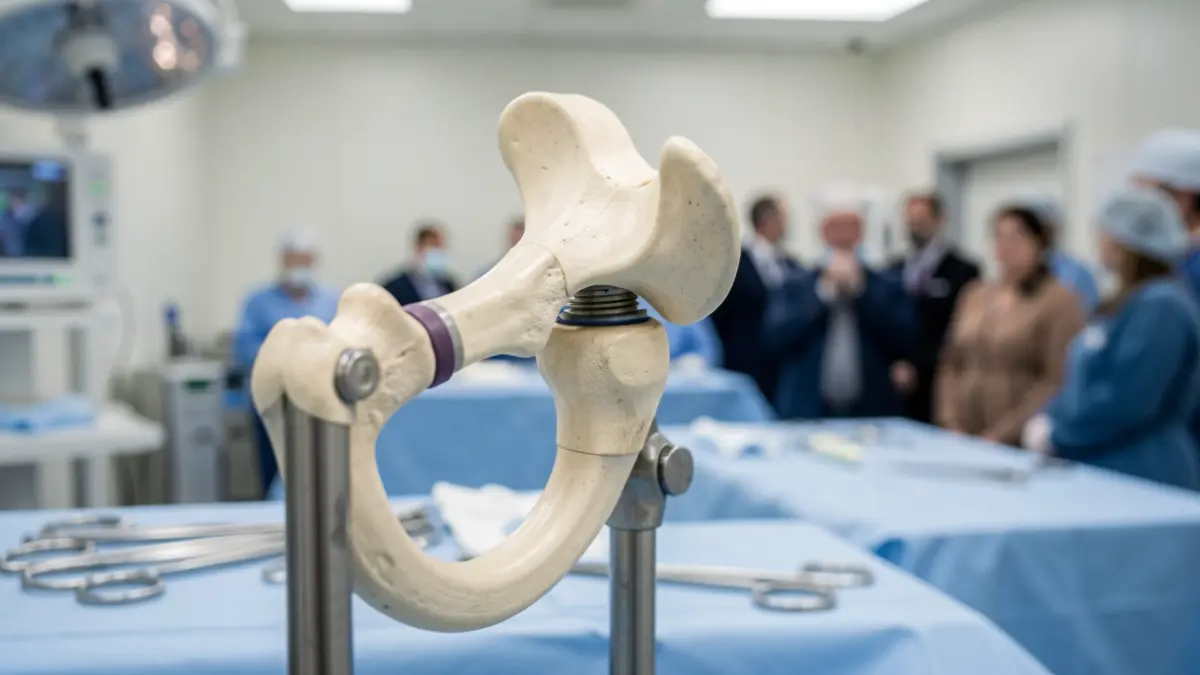
Vithas Valencia Turia Hospital has become the first private center in the province to successfully perform simultaneous bilateral hip prosthetic surgery using the anterior approach. This procedure allows for the replacement of both joints in a single surgical act, offering highly favorable outcomes in terms of functional recovery, postoperative comfort, and patient autonomy.
The first three patients operated on have shown exceptional progress, regaining full mobility within 8 hours of surgery and being discharged from the hospital in under 12 hours. Their postoperative period has been virtually pain-free, without the need for opioid analgesics.
The operations were led by Dr. Ismael Escribá, from the Hip Unit of the Orthopedic Surgery and Traumatology service at the center. Dr. Escribá is a leading figure in the anterior approach, a minimally invasive technique that accesses the joint without cutting muscles or tendons, establishing itself as one of the most efficient and safe procedures.
“"I admit I went into the surgery with quite a bit of apprehension, thinking the recovery would be much tougher than it turned out to be. In fact, one of the things that surprised me most was when, just a few hours after the operation, the surgeon came to see me and told me I could get up and start walking. At that moment, it seemed incredible. Recovery has gone well since day one. I've been able to manage quite independently and have hardly needed to rely on my wife, who was going to look after me during this process. I even experienced something I never would have imagined before the surgery: I haven't needed to take any painkillers. My experience has been frankly positive, and I wouldn't hesitate to recommend it."
Simultaneous bilateral surgery offers significant benefits compared to two separate interventions over time. The patient undergoes a single anesthesia and hospitalization, reducing cumulative anesthetic risk and notably shortening the overall hospital stay. It also decreases the anxiety associated with a second surgical procedure and allows for unified, more efficient rehabilitation with faster overall functional recovery.
“Correcting both hips also promotes more symmetrical gait and an early return to usual activities,” notes Dr. Escribá. He adds that “this type of intervention has a lower total economic impact, both for the healthcare system and the patient, in terms of sick leave days and travel, with fewer interruptions in their daily lives.”
According to Dr. Escribá, the anterior approach is key to the success of simultaneous bilateral intervention. Unlike traditional approaches, this method allows working between muscle planes without sectioning structures, reducing postoperative pain, bleeding, and dislocation risk, while facilitating functional recovery. The absence of movement restrictions and preservation of musculature allow patients to regain physical independence from the first few hours.
From a surgical standpoint, this technique facilitates rigorous planning of both sides with intraoperative fluoroscopy, ensuring optimal size and position of prosthetic components, as well as offset and length. “Achieving biomechanical symmetry of both hips is thus easier,” states Dr. Escribá.
Simultaneous bilateral surgery is not indicated for all patients. It is a valid and beneficial option for individuals with symptomatic bilateral hip osteoarthritis who meet strict criteria related to their general health, cardiopulmonary reserve, body mass index (should not be elevated), absence of coagulopathies, and ability to adequately follow the recovery plan, along with necessary family or social support.
As Dr. Escribá emphasizes, the key is not only being able to undergo the surgery but doing so with safety and the necessary guarantees for a good recovery. “The technique requires an experienced team, meticulous planning, and a prepared hospital infrastructure to respond to the particularities of this procedure.”
With its consolidation, Vithas Valencia Turia Hospital reinforces its commitment to high-precision, minimally invasive medicine focused on improving the patient experience, positioning itself as a reference center for high-efficiency hip surgery.