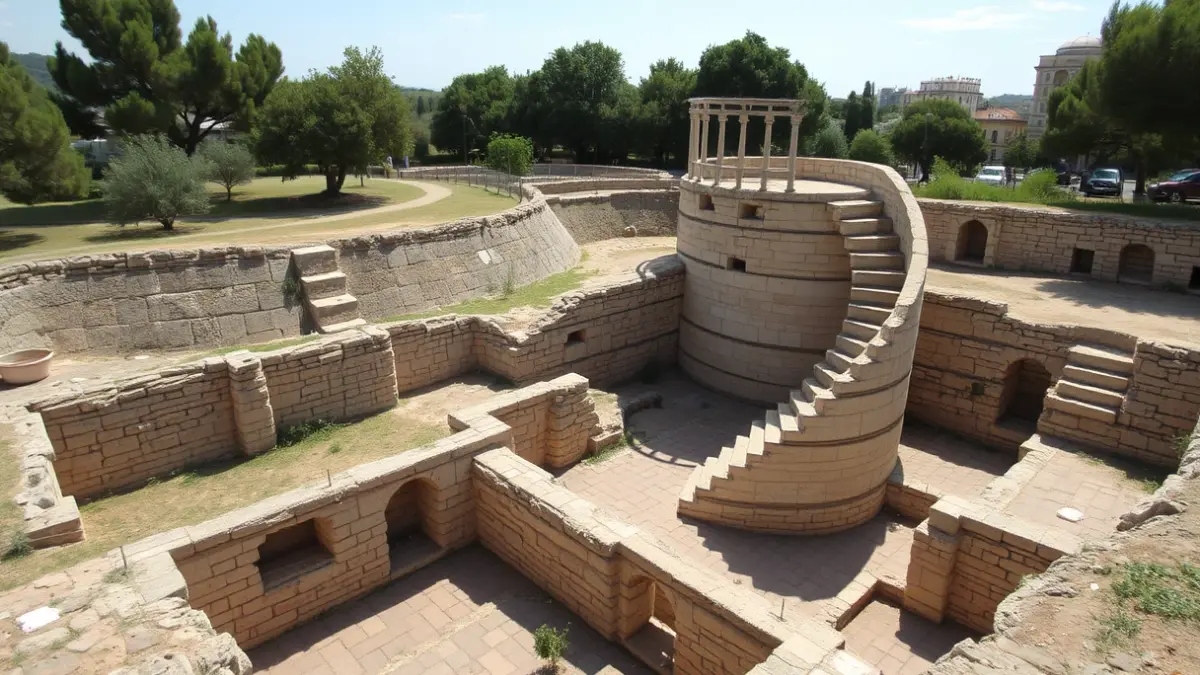
The complex process of relocating Torre Placia, a Site of Cultural Interest (BIC), has encountered new setbacks, this time of a positive nature. During its dismantling and piece-by-piece reconstruction at its new location, a municipal plot designated as a green area next to Héctor and Juana Francés Park, several previously undocumented historical elements have been identified.
The work carried out by the company Estudio Métodos de la Restauración has allowed for the discovery of remains of the original spiral staircase that connected the first levels of the building. Additionally, fragments of the walls of the old farmhouse that was later annexed to the tower have also been found. Finally, the need for archaeological supervision work at the monument's destination plot, which is part of the historical complex of the Torres de la Huerta, has been detected.
The identification of these unforeseen elements requires the formulation of a project modification to incorporate them, which will entail a variation in the contract conditions, both in cost and time.
These discoveries imply the need to modify the initial project, which will lead to further delays in the completion of the work. The proposal from the company responsible for the relocation, which prompted the suspension of work in late February, already has the support of the technical management. The new costs and deadlines for a project initially contracted for 1,769,777 euros and expected to be completed in six months, and which has already had two previous extensions, are still unknown.
The last extension expired on March 31, and the redevelopment of the plot, the identification of the old annexed farmhouse, and the reproduction of the access paths to the tower still need to be completed. The external reconstruction of the building is reportedly finished, pending the recovery of the newly unearthed spiral staircase.
The project also included the consolidation of the original location on Clara Campoamor street. The tower's relocation was prompted by a 22-year-old ruling from the Superior Court of Justice (TSJCV), which ordered the demolition of eleven single-family homes that encroached on the tower's protected area. The Alicante City Council proposed relocation as an alternative to minimize costs and prevent the displacement of owners, a solution accepted by the TSJCV and the Ministry of Culture, provided that the monument's preservation and its historical defensive role were guaranteed.