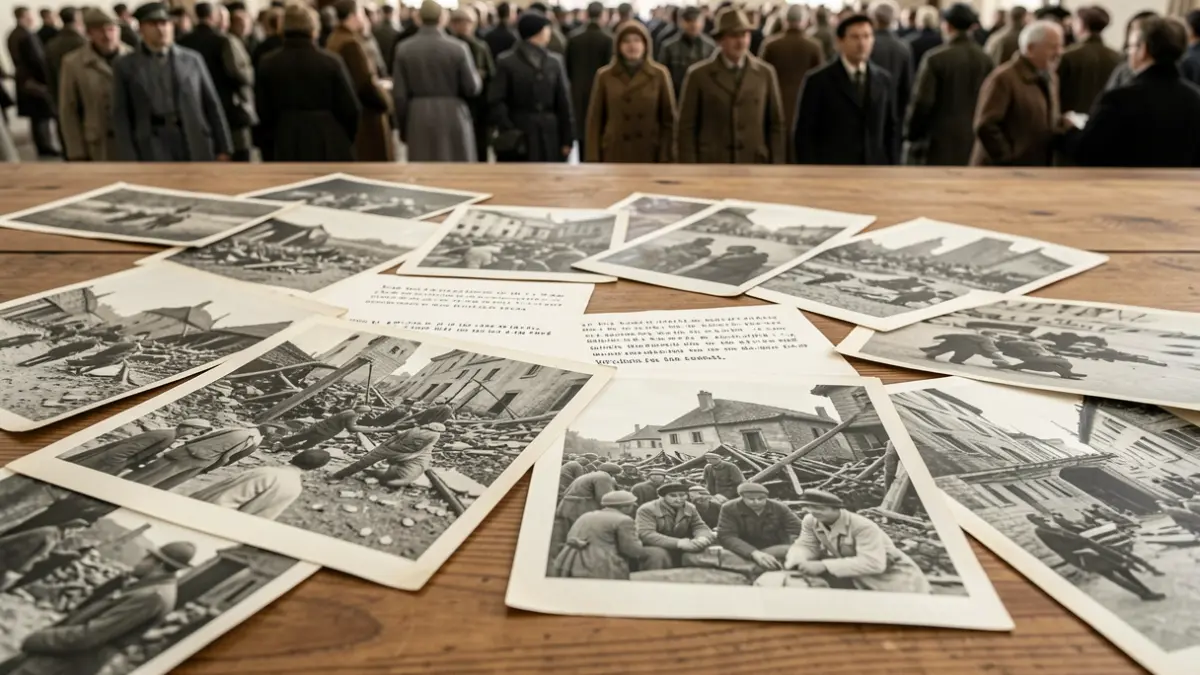
The University of Alicante has opened an exhibition in the lobby of its General Library, showcasing for the first time a significant collection of previously unseen photographs from the Spanish Civil War. The exhibition, titled 'The Spanish Civil War in the Keystone Agency's Photographic Archive,' features part of a collection recently incorporated into the Archive of Democracy.
The archive was a donation from the Díaz Lisón family, facilitated by Paola Concepción Masseau Díaz, Vice-Dean of Academic Planning at the Faculty of Philosophy and Letters. The legacy, handed over to the General Archive of the University of Alicante a few months ago, comprises 135 original photographs from the Keystone and Fulgur agencies, taken between 1935 and 1939.
The images originate from the Parisian headquarters of Keystone, one of the most influential photojournalism agencies of the 20th century. This origin lends special historical value to the collection, as much of the material had not been seen in Spain before. The snapshots were created for distribution to French and European media, explaining why they were not part of archives held by other Spanish institutions.
The collection depicts some of the main conflict zones, with photographs taken in locations such as Madrid, Aragon, the Valencian Community, Andalusia, or the Basque Country, alongside images of cities devastated by bombings. It also shows combatants at the front, militia members, military parades, daily life in the rear, and civilians affected by the war, as well as refugees and exiles who arrived in France.
One of the most unique elements is the documentation accompanying each image. The reverse sides preserve typed notes in French sent to the agency's Paris office, identifying locations, dates, authors, and various archive codes used for managing the graphic material. The archive's history is linked to the exile of the Díaz Lisón family in France, where a relative with a passion for collecting acquired the photographs from a second-hand market.
The exhibition displays 55 original photographs, along with publications, postcards, and correspondence from other holdings in the Archive of Democracy. Additionally, a monitor allows viewing of 67 other images that could not be physically exhibited due to space constraints. All material has been described, digitized, and added to the Archive's catalog.
The Vice-Rector for Culture, Sport, and University Extension, Catalina Iliescu, highlighted the collection's historical and emotional value, describing it as 'magnificent' and 'moving' for its quality and the opportunity to see 'those young people who gave their lives to defend their ideals'.
Iliescu attended the inauguration accompanied by Emilio Rosillo, Director of the Archive and Registry Service of the University of Alicante and the Archive of Democracy; Rosana Gutiérrez, coordinator of the Archive of Democracy's advisory council; and Paola Concepción Masseau, representing the donating family. The initiative is part of the programming for International Archives Week, and the exhibition can be visited until June 22.